

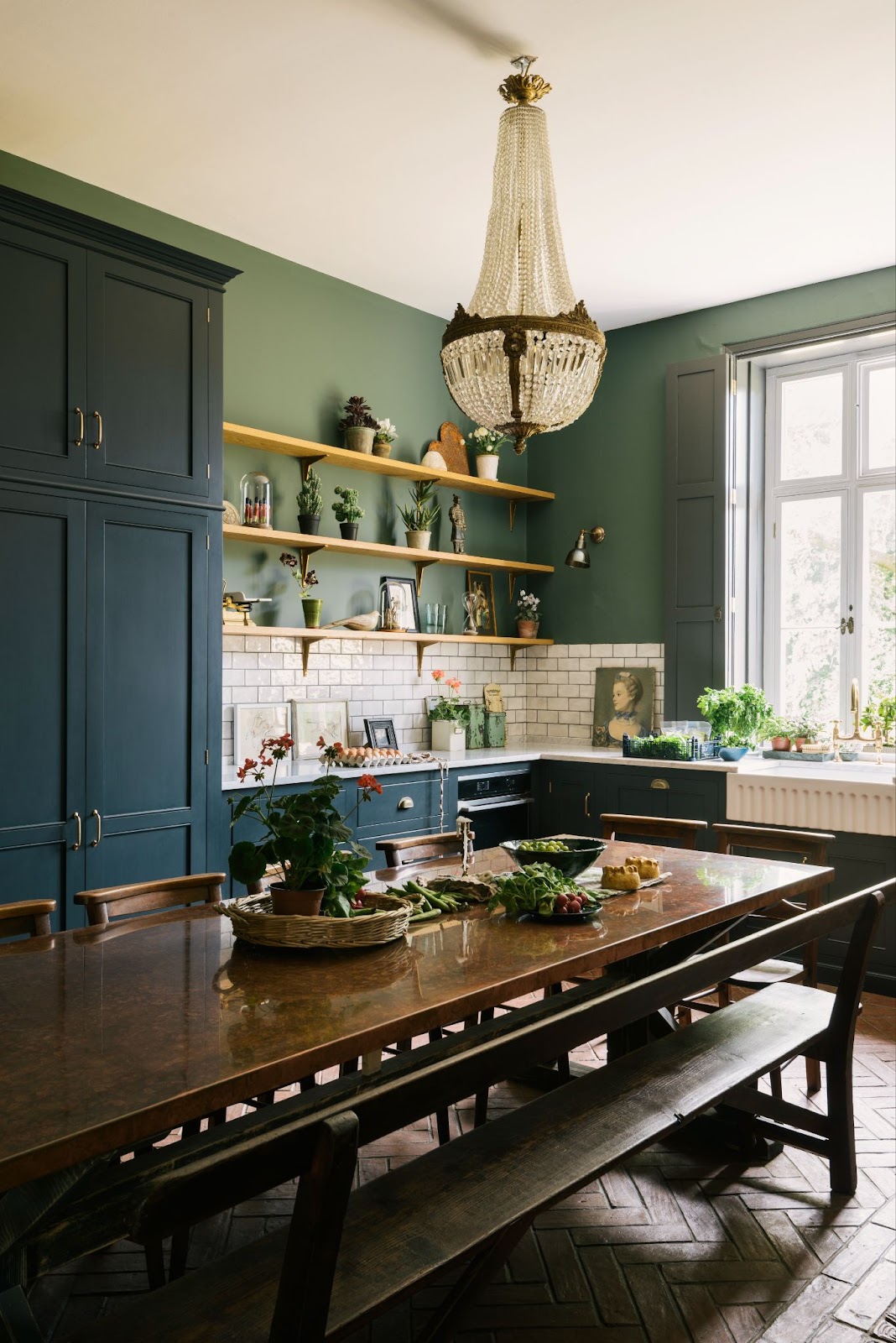
In a recent Wall Street Journal article I read, the Design and Decorating section discussed why some people are trending away from having kitchen islands and opting for a dining table instead.
Back in the 80’s and 90’s, I remember going to friends houses and seeing big kitchen islands and thought to myself as a young teenager, “wow they must be rich”. And who knows, that may have been true for some families where I was from on Long Island. Then in the 90’s, everyone had one. It was actually expected for home builders to include them when designing a new home. People wanted the island.
Early on, the concept of a kitchen island dates back to the 1800s with traditional European homes having worktables in front of stoves.

1930s:
Frank Lloyd Wright began designing houses for the middle class, incorporating islands that allowed families to stay in touch with guests while preparing food.
1940s -1950s:
Built-ins were big, and islands started to emerge as a way to add extra counter space and storage.

1970s & 80s:
As open floor plans became more popular, and appliances took up more space, islands evolved into a practical solution for extra prep space and storage.

1980s & Beyond:
The island became a focal point for gathering and entertaining, with designs evolving to include "eat bars" and other features.

Flexibility and Versatility: Kitchen tables afford homeowners greater flexibility in design and functionality compared to islands. They can be relocated within or outside the room if needed, offering convenience and adaptability.
Many dining tables have an extension leaf feature that allows you to enlarge the space during special events and then condense it afterward, optimizing space efficiency—a key aspect making these tables versatile and functional for multiple kinds of dining settings and spatial layouts. Whether you chose to be trendy OR traditional, choose what suits your family and your space. Many hours will be spent in the kitchen cooking, gathering with friends and family or simply enjoying the space you designed with intention and love. Make those moments memorable. For more information on creating your perfect kitchen, contact us at Molto. We look forward to hearing from you.



An island is a feature of many kitchens, and wanted by many people who don’t have one. But is it something that counts as a necessity, or is it simply good to have? Or perhaps it could be a kitchen feature you really should avoid?It’s true to say that an island is a staple on many a wish list of kitchen ideas, but while that proves it is ultra-desirable, it doesn’t indicate it’s an essential in terms of the room’s functionality, nor its aesthetic appeal.How does someone answer the question of whether you need a kitchen island?

Good news: kitchen design is taking a thrilling leap forward! The fusion of style and practicality has always been at the heart of culinary spaces, but trends are redefining that delicate balance in exciting ways. Design is dishing up a mouthwatering blend of innovative materials, smart technology, and a dash of eclectic flair. Get ready to feast your eyes on the hottest kitchen trends 2024!
